Young Jews Gather Across Queens, Brooklyn, and Manhattan, Find Community Amid Global Upheaval
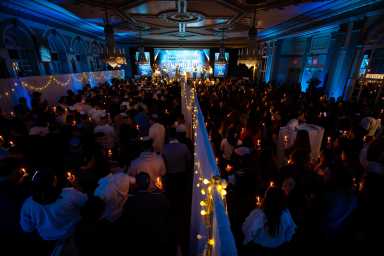
In the aftermath of recent crises, young Jewish professionals from across the globe converged in New York to reinforce community ties, offering a data point in the evolving calculus of urban solidarity and diaspora identity.
It takes more than a spike in anti-Semitic incidents to keep over 1,000 young Jews from gathering in New York City. For four days in June, attendees aged mostly in their 20s and 30s huddled in meeting halls and auditoria from Queens to Manhattan, sharing stories shaped not only by professional ambitions but also by a shared sense of global unease. Amid ongoing hostilities in the Middle East and a noted uptick in hate crimes closer to home, this International Young Jewish Professionals Leadership Summit, organized by Chabad, came almost as an act of resilience.
The event—stylised the Chabad Young Professionals Encounter—drew participants from nearly 100 cities and 30 countries, including such disparate outposts as Montana, Singapore, Estonia, Taiwan, France, and both Brooklyns (the borough and Birmingham, Alabama). Attendees swapped tales, learned from a roster of lecturers, and kindled connections that spanned continents. Their agenda: not only to commiserate about challenges, but also to seize the moment to celebrate, in the words of Chabad spokesman Avi Winner, “our identity”—a commodity suddenly more precious, if not more precarious, since October 7th 2023.
At the heart of the programming were workshops, keynote addresses, and, tellingly, solemn commemorations—such as a mass candle-lighting that drew more than 1,000 in New York and hundreds more online from as far afield as Australia. These rituals gave heft to the summit’s purpose: shoring up a sense of togetherness in a time increasingly defined by division. Attendees were reminded, with some irony, that even in their diversity—by birthplace, profession, or political temperament—they found themselves singing the same songs.
In its particulars, the summit was unmistakably a New York affair. Some proceedings unfolded in the capacious, if unglamorous, Performing Arts Center at Queensborough Community College. Speakers included Eliya Cohen, a survivor of 505 days as a hostage in Gaza, hedge fund founder Igor Tulchinsky, and startup philanthropist Teddy Raskin. Musical interludes featured Shulem Lemmer of Universal Records. The setting, urbane yet unvarnished, provided a fitting backdrop for the unforced cosmopolitanism on display.
For New York, the event seemed both celebration and gauntlet. The city houses the largest Jewish diaspora community outside Israel; it has, over generations, offered a haven, an incubator for religious and secular identities alike. Yet security concerns now hang heavier in the air. The NYPD recorded an uptick in reported anti-Semitic incidents corresponding with global flashpoints. In this context, the simple act of convening—let alone celebrating—acquires a quietly defiant cast.
As with many conferences, the summit’s louder impact may not surface immediately. The cross-border networks forged here will filter back into diverse communities. Several participants noted the uncanny uniformity of experience: “We kind of have the same life, because we’re Jewish,” observed one Parisian attendee. Such admissions, perhaps trite on their surface, hint at the psychological salves these gatherings provide: insulation against an otherwise atomising zeitgeist.
After terror, renewed identity
The event’s resonance did not end at city limits. A transnational candle-lighting, paired with a live link to Australia’s Bondi Solidarity Concert—eloquently commemorating victims of a Chanukah-season attack—demonstrated the ease with which diaspora communities now operate in the digital ether. Technology made physical borders almost irrelevant; kinship was asserted by bandwidth as much as by proximity.
Those second-order effects extend beyond self-reassurance. Jewish civic activism, catalysed by events like these, buses its energy back into American politics, philanthropy, and professional networks. City Hall and Albany keep an anxious eye on communal sentiment—even as they calibrate budgets and policing strategies to respond to shifting risk. The city’s commercial life, too, benefits from the networking impetus and cross-sector collaboration springing from events that, on their face, are deeply local but ecumenically global.
Beyond New York, summits of this ilk sketch a pattern seen across the post-pandemic West: affinity groups, sensing the limits of broad-spectrum liberalism, doubling down on mutual support structures. In Paris, London, Buenos Aires or Sydney, Jewish organisations have marshalled similar events, mixing celebration with communal alarm. What distinguishes New York’s version is its scale—and, perhaps, its ability to mirror the polyglot exuberance (and anxieties) of the city itself.
There is a danger, of course, that as solidarity thickens within, connection across lines may fray. The city’s leaders would do well to recall that resilience must not curdle into insularity—a trick that, as any student of Gotham’s history will recall, is hard to master but perilous to ignore. Still, if data is any guide, such events more frequently generate bridges than barricades: for every moment of cloistered reflection, there are two of outward-facing engagement, from philanthropy to the not-so-humble bagel brunch.
In the final analysis, what does a four-day summit of youthful vigor portend for the metropolis? Perhaps less than its organisers hope, but more than cynics would allow. New York’s genius has always lain in its ability to absorb waves of anxious newcomers and turn their fears, slowly, into fuel for urban renewal. That process has not gone out of fashion—nor, we suspect, will it.
At a time when “identity” is as liable to divide as to unite, events such as this summit may provide a formula for healthy pluralism: firm on particularism, open to exchange, implacably rooted in place and, paradoxically, nowhere at all. As gathering storms gather, that may prove a New York value worth exporting. ■
Based on reporting from QNS; additional analysis and context by Borough Brief.