Queens Rains Flood Basements Again as Albany Considers Stormwater Fix That Might Finally Fit
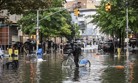
As New York City’s sewers buckle under unprecedented rainfall, the only thing rising faster than the water is the urgency for a modern, climate-resilient infrastructure.
Citibikes bobbed through brackish currents in Brooklyn; commuters in Queens huddled on platforms as water cascaded through the Bayside station, stalling trains and tempers alike. On August 1st last year, a midday deluge overwhelmed vast stretches of New York City with unremitting efficiency. Basements choked with water, businesses shuttered, and residents in Northeast Queens faced a now-familiar aftermath: mopping up before forecasting the next maelstrom.
A mere twelve weeks later, the city received a punishing encore. On October 30th, a record downpour again paralyzed streets, submerged subways, and this time ended two lives—among them, Juan Carlos Montoya Hernandez, discovered in his own Washington Heights apartment. The tragedy, in a neighborhood not known for flood risk, underscores the caprice of climate-induced storms. Rainfall records may not capture emotion, but they offer cold proof: The city’s defense against extreme precipitation is inadequate for both the poor and the well-heeled.
Nor are such calamities one-off events. In 2021, over a dozen Queens residents perished when Hurricane Ida’s remnants breached all expectations and cellar doors. Such fatal episodes, now occurring with punishing regularity, confirm what the federal 2023 National Climate Assessment soberly records: The American Northeast endures more frequent and intense rainfall than any other region. In New York, the consequences are notably grim given the city’s antiquated, impermeable infrastructure and its mismatched sewer capacity.
At the sharp end of this trend are communities already disadvantaged by history. Thanks to decades-old sins—redlining, discriminatory housing finance, concentrated zoning of industrial uses—Black and Hispanic neighborhoods like East Harlem and Howard Beach face a risk compounded by bad policy. Projections show flood odds in Black communities soaring by as much as 20% over the next quarter-century. When climate meets concrete legacy, the result is social as well as physical inundation.
The culprits and costs are legion. New York’s tangled web of storm drains, boasting more vintage than capacity, simply cannot keep pace. There are 11,000 new rain gardens scattered across the five boroughs—verdant, somewhat optimistic oases intended to soak up surface runoff. Small wonder this proves a paltry counterweight when facing the combined onrush of seawater, stormwater, and sewage. The Department of Environmental Protection’s “cloudburst management” schemes show promise, aiming to retrofit streets and playgrounds to absorb sudden deluges, but the scale and urgency required dwarf present efforts.
Homeowners and businesses, meanwhile, pay a heavy toll—in ruined furniture, lost income, corroded confidence, and, most heartbreakingly, lost lives. Insurance claims, where available, lag behind need. Many New Yorkers now eye rain clouds as harbingers of disaster, not relief, with those lacking means to move or renovate at greatest risk.
Financially, the price is astounding. The city spends billions shoring up seawalls and retrofitting subway vents, but ever costlier storms continue to expose the limits of these stopgaps. The MTA alone estimates potential damages from storm surge in the multibillion-dollar range. Without systemic investment, each new downpour hints at mounting fiscal liabilities lurking beneath city streets.
Politically, discontent swells almost as rapidly as floodwaters. Citizens expect, not unreasonably, that local government can weather-proof basic infrastructure. Albany’s legislative response, the Rain Ready New York Act (S4071/A7476), aims to address that expectation. In mundane terms, the bill would update legal definitions, formally expanding the scope for stormwater solutions in state and city infrastructure planning. Modest in text, the measure’s underlying ambition is clear: empower city agencies to modernize networks and formally prioritize rain preparation over mere reactivity.
Stormwater, city law, and the price of inertia
The Rain Ready New York Act is not, in itself, a panacea. Yet legislative housekeeping may, as often in New York governance, prove necessary for the grander projects ahead. By clarifying the city’s remit over “stormwater”—previously an orphaned category in decades-old legal codes—officials hope to unlock both policy bandwidth and, crucially, funding. Without these legal reforms, the city’s most ambitious green infrastructure plans can be stymied by bureaucratic semantics.
Compared to global peers, New York’s predicament is embarrassingly familiar. Jakarta, Mumbai, and London alike wrestle with sewage systems from past centuries—ill-suited to swollen metropolises and even further from withstanding a changing climate. London’s “Super Sewer” and Copenhagen’s cloudburst boulevards offer instructive, albeit not always easily portable, models for large-scale adaptation. Yet New York’s scale, diversity, and political structure demand custom-tailored responses both bolder and more nuanced than patchwork solutions.
We reckon there is cause for cautious optimism. The city’s technical expertise is, in general, world-class; political will to act on flooding exists across party lines, in part because floodwater is peculiarly nonpartisan. Yet it is tempting, and dangerous, to believe that incremental measures will suffice. As evidence mounts—in waterlogged basements, lost lives, emergency budgets—the case for a thorough overhaul grows less an option than an imperative.
Neither rain gardens nor paperwork alone will rescue New York from the deluge sustained by warming atmospheres and rising seas. Only a mixture of political courage, technical rigor and sustained investment will preserve the city’s vaunted resilience from becoming an empty boast. To paraphrase a famous local: Hope is not a plan, even when the clouds clear—for the next time, and the times after that, are already on their way. ■
Based on reporting from City & State New York - All Content; additional analysis and context by Borough Brief.