Queens’ Corona Health Sanctuary Playground Nets Share of $50 Million City Parks Overhaul Fund
Targeted investment in New York’s long-neglected parks may offer a rare chance to close quality-of-life gaps that have stubbornly endured across the city’s neighbourhoods.
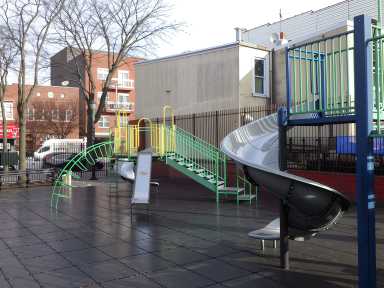
Corona Health Sanctuary Playground, an unassuming sliver of tarmac and grass sandwiched between 104th and 106th Streets in Queens, is hardly the stuff of urban mythology. Its faded basketball court and patchwork picnic tables, however, are emblematic of the ordinary green spaces where over 8 million New Yorkers carve out some respite—or resign themselves to urban neglect. On a recent afternoon, soccer balls thudded against dented fences while a lone patch of grass hinted at what could be, given attention.
That overdue attention has arrived. In early March, Mayor Zohran Mamdani and Parks Commissioner Tricia Shimamura announced a $50m capital infusion for ten chronically overlooked parks—Corona’s among them—via the city’s Community Parks Initiative (CPI). Launched in 2014 to redress the chronic deficit in green space quality across the boroughs, CPI’s new round for fiscal 2027 includes not only this corner of Queens, but stretches of the Bronx, Manhattan, Staten Island and Brooklyn that have languished for decades.
Of the ten parks greenlit for investment, Corona Health Sanctuary is the lone Queens representative. Elsewhere, Mott Playground, Morris Mesa, and the Fountain of Youth sites bring a glimmer of hope to the Bronx, while St. Nicholas and Vladeck Parks in Manhattan join Brooklyn’s neglected Roebling, Van Dyke, Elizabeth Stroud Playgrounds and Staten Island’s Kaltenmeier Playground. For thousands of local families, these spaces function as de facto backyards—a public commons standing in for private amenities.
This, city officials argue, is no mere ribbon-cutting or ornamental landscaping. The $50m, they say, will fund full-scale makeovers—from sports facilities and lighting to wheelchair accessible paths and new play features. In a city where the average price of private outdoor space verges on the absurd, equitable public parks are more than a civic frill; they are essential infrastructure.
Championing the investment as a win for public health and civic pride, Mamdani remarked that “the park is their backyard”: a point concrete for roughly 100,000 residents who live within walking distance of the ten chosen sites. Studies bear out his optimism; research from the Trust for Public Land finds that ready access to quality parks is linked to lower rates of obesity, higher reported wellbeing, and—perhaps most salient for post-pandemic New York—a spike in social cohesion and informal childcare.
Yet, the mayoral largesse, while welcome, is also a tacit admission of longstanding neglect. CPI’s own process for selection highlights uncomfortable data: recipient parks have, by definition, seen little public investment in 20 years. The city’s historic approach, driven by property tax yields and private philanthropy, has repeatedly favoured Central Park or the High Line over hardscrabble playgrounds on the city’s ragged edges. Inequality thus persists not only in tax brackets but in the quality of the benches and fields New Yorkers use to escape their apartments.
Second-order effects are not merely aesthetic. Well-maintained parks have been shown to buttress local economies by moderating urban heat, filtering air pollution, and even dampening crime rates. For immigrant-heavy enclaves like Corona, where population density verges on the threefold city average and median incomes remain modest, public space is not an afterthought but rather the glue of community life. Underfunded parks exacerbate spatial inequities—boding ill for intergenerational mobility and undermining claims of citywide fairness.
The political economy of New York’s green spaces remains a curious study in municipal priorities. In 2022, the city devoted less than 1% of its gargantuan $100bn budget to parks and recreation—close to the lowest share among major U.S. cities. Successive mayors have spoken eloquently of playgrounds as “great equalisers,” yet have treated them, fiscally at least, as optional. The CPI, now restoring its 70th site since inception, remains the exception that sustains the rule.
Balancing promises with maintenance
A further caveat haunts the new capital push: initial investment, however ballyhooed, must be paired with ongoing maintenance for benefits to persist. New York’s parks department operates with staffing and operating budgets lagging pre-pandemic norms, leaving even spruced-up playgrounds prey to disrepair and vandalism. Nor is inflation standing still; beset by rising labour and materials costs, the final price tag may outstrip the current $50m allocation, with delays all but inevitable.
Nationally, New York’s belated focus on park equity is far from unique. Rival cities—Boston, Seattle, Minneapolis—have inched further along the path, using careful data to steer investments toward those who need it most. Internationally, the likes of Copenhagen and Singapore have made green equity a lodestar of urban planning, with prized outcomes in public health and civic trust. For New York, catching up will take both resolve and creativity—a point that cannot be glossed with ceremonial shovels and photogenic politicians.
Still, there is cause for cautious optimism. Past CPI projects have shown that even modest upgrades—shade trees, new turf, reliable toilets—can transform how residents interact with their own blocks. At best, parks become not only sanctuaries from congestion, but seeds of social capital in neighbourhoods squeezed into anonymity by the market.
Ultimately, the test is whether new fences and playsets translate into daily improvements for children, parents, and the elderly. The gap between promise and delivery is often wide enough to fly a police drone through. Yet as economic divisions threaten to harden, measures like the CPI represent a rare municipal lever for tilting the playing field—figuratively and literally—towards parity.
We reckon that public parks are among the most underrated investments a city can make for its people. The disrepair of places like the Corona Health Sanctuary has long symbolised the city’s patchwork approach to equity. With measured follow-through, the latest $50m could do something that dotted mayors’ speeches rarely achieve: narrow gaps that matter, right where New Yorkers live, play, and hope. ■
Based on reporting from QNS; additional analysis and context by Borough Brief.