MLK Day Marchers Cross Brooklyn Bridge Demanding ICE Reform and a Return to Rights
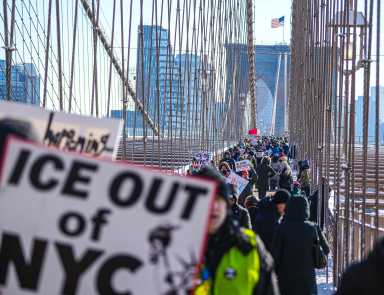
Amid winter’s chill, hundreds march across the Brooklyn Bridge on MLK Day, tying the civil rights legacy to demands for an end to harsh immigration enforcement and a warning against creeping authoritarianism in America.
On a frigid January morning, when many New Yorkers would sooner huddle indoors, several hundred people gathered at Cadman Plaza, Brooklyn, their numbers swelling with resolve rather than comfort. From here, banners aloft and chants echoing, they crossed the Brooklyn Bridge to Lower Manhattan. Their chosen route was no accident; it was choreographed symbolism, retracing paths once trodden by marchers for justice. But this Martin Luther King Jr. Day, as they flowed towards 26 Federal Plaza—home to New York’s immigration court—the protestors’ focus was as much on present perils as on the heroic legacy they invoked.
Organised by local civil rights leaders, with the support of the New York Immigration Coalition and bolstered by city Public Advocate Jumaane Williams, the march condemned what they called the “rise of tyranny” in America. The immediate object of ire was the federal Immigration and Customs Enforcement agency (ICE), and especially its recent operations in New York. The recent killing of Renee Good, a Minneapolis mother shot by an ICE agent, ignited this particular outcry, referenced repeatedly in fiery speeches delivered beside the Brooklyn Bridge.
According to organisers, the message was twofold: to commemorate Dr King’s vision not as static memorialisation, but as a continuing mandate; and to protest what they see as the encroachment of authoritarian tactics—racial profiling, family separation, and armed presence—upon the city’s immigrant communities. Their rally at 26 Federal Plaza spotlighted the routine of masked agents detaining immigrants as they attend court hearings, a ritual both chilling and mundane in today’s New York.
Such protests are regular features of the metropolitan calendar, but the scale and timing this year hint at something more substantial. Recent federal data show that New York City’s non-citizen population—more than 3 million by some counts—lives with palpable anxiety. Arrests and deportations conducted by ICE in fiscal 2023 ticked up 18% citywide. Legal advocates point to the particular vulnerability of immigrants who arrive for mandated check-ins or hearings, only to be whisked, sometimes unannounced, into custody.
The city’s leadership is officially caught in the crossfire. Mayor Eric Adams’s administration has repeatedly sparred with federal authorities over the placement of newly arrived migrants, while also seeking more federal dollars for their support. Public Advocate Williams, a fixture at such protests, channels grass-roots worries to City Hall but wields little direct power. The momentum for change, therefore, remains largely performative—a metaphoric crossing of bridges, rather than a forging of policy.
Yet, as any student of this city’s history will point out, shrill activism has often been a precursor to substantive change. The 1960s civil rights marches cited on Monday ultimately rebalanced New York’s social contract, if only after prolonged institutional resistance. The echoes are not lost on today’s protesters, nor on employers in the city’s $1 trillion economy who rely on immigrant labor—57% of the city’s workforce are first- or second-generation Americans, according to the New York Comptroller’s office.
The march’s implications extend well beyond ICE’s remit. In the background looms New York’s housing crisis, with tens of thousands of asylum seekers packed into makeshift shelters, and concerns about gentrification crowding out legacy communities. Local businesses fret that crackdowns on immigrants will further suppress an already tepid retail sector, while hospitals warn that fear of enforcement drives people away from seeking care—heightening public health risks.
On the political front, the city’s activism collides with national headwinds. The Supreme Court’s decision in United States v. Texas (2023) allowed states to challenge the Biden administration’s attempted overhaul of ICE priorities, emboldening hardliners. Congressional gridlock on comprehensive immigration reform ensures that the underlying machinery of deportations and detentions continues, mostly unchecked.
National shadows and global comparisons
Compared internationally, New York’s dilemma is hardly unique, but the optics are especially stark. European metropolises face their own struggles over asylum, integration, and policing of borders, but few can match the United States in the scale and opacity of federal immigration enforcement within its cities. Local officials are often powerless to intervene, a federalism that portends both confusion and paralysis.
Meanwhile, polling portends polarisation ahead of November’s elections, with immigration a wedge issue likely to drive turnout. American attitudes are curiously volatile: a recent Gallup poll found that public support for granting citizenship to law-abiding undocumented migrants remains above 60%, even as anxiety about border “crises” dominates cable-news airwaves. For Democratic-leaning cities like New York, the contradiction is palpable: sympathy for the individual migrant, and suspicion of the system as a whole.
We are sceptical that Monday’s demonstration, stirring as it was, will trigger immediate policy shifts at any level. ICE’s operational protocols remain mostly insulated from public sentiment, and federal lawmakers show little appetite for reform amidst presidential-year grandstanding. The marchers’ demand to “end tyranny” reads, in this political climate, as both aspirational and illustrative of the times: a cri de coeur from a polity weary of incrementalism.
Still, such displays of civic energy are not entirely wasted. They keep New York’s moral conscience on a slow simmer, and help remind the country—if it cares to listen—that the arc of justice bends only when pushed. The protesters’ invocation of King is apt, if occasionally overwrought; the city, for all its flaws, remains a bellwether for the rights of minorities and newcomers. That is a legacy worth reaffirming, even if progress remains stubbornly non-linear.
With shrinking patience on both sides of the national debate, New York’s civil spirit is unlikely to abate. The next crossing of the Brooklyn Bridge, history suggests, is always on the horizon. ■
Based on reporting from amNewYork; additional analysis and context by Borough Brief.