At BAM, Mayor Mamdani Ties Black Family Exodus to High Costs, Pushes Tax Hikes
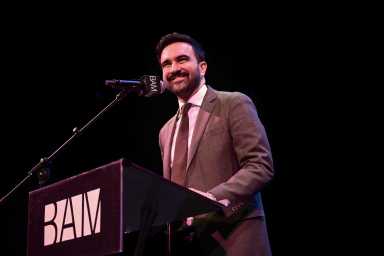
Mayor Zohran Mamdani’s call for higher taxes on New York’s wealthy turns municipal budget wrangling into a referendum on who—and what—the city truly values.
It is rare for a mayoral address on Martin Luther King Jr. Day to unsettle both Wall Street and City Hall, yet that is precisely what Mayor Zohran Mamdani accomplished at the Brooklyn Academy of Music this week. To a rapturous crowd, he invoked not only Dr. King’s vision of racial justice but also the ebbing presence of Black families in New York, wielding raw statistics rather than oratory alone. “Why is there no focus on the exodus of fact?” he asked, pointing to a nearly 20% exodus of Black youth over the last decade. Dismissing warnings of a tax-induced billionaire departure as overblown, Mamdani turned the city’s perennial anxiety about the mobility of its rich on its head.
The mayor’s remarks came as he outlined his proposal to raise taxes on the wealthiest New Yorkers, a plan that—if adopted—would see the state’s corporate tax rate climb from 7.25% to a punchy 11.5%, and personal income taxes rise for those earning north of $1 million. With the city’s coffers perennially strained, Mamdani has anchored his pitch in a familiar but potent refrain: New York’s “wealth beyond measure” is paired, stubbornly, with some of America’s starkest inequality. The mayor’s pointed invocation of Dr. King’s economic vision signalled a deliberate alignment of fiscal policy with civil rights rhetoric, aiming to nudge New York’s progressive politics from poetry to prose.
For the city’s Black residents, particularly in its bus-dependent outer boroughs, the costs of inequality are grimly tangible. Mamdani cited not only the stratospheric average cost of childcare—$26,000 a year, a sum euphemistically described as “a good deal”—but also a healthcare system where Black mothers are nine times more likely to die from pregnancy-related causes. In crowded classrooms, sluggish commutes, and patchy service coverage, policy failures manifest almost physically. The mayor’s solution—or at least the funding for it—demands more from those who have most enjoyed the city’s post-pandemic financial boom.
The current exodus, Mamdani argued, originates less from punitive tax rates than from the punishing economics faced by families priced out of the city. Between 2010 and 2019, New York lost approximately one in five of its Black children and teenagers—a demographic not known for holding equities or fleeing to Miami at the first whiff of surtaxes. To the mayor, this flight is less a product of “individual decisions,” as civic fatalists like to claim, and more the predictable consequence of policies that have failed—or declined—to invest meaningfully in public goods.
Opponents of Mamdani’s tax plan, notably Governor Kathy Hochul, have not been swayed. The governor has firmly ruled out new taxes on high earners, touting a budget balanced through relatively tepid spending controls and state aid. Business groups, ever vigilant for creeping tax creep, warn that the proposed rates would tarnish New York’s competitive edge. National lobbies echo the spectre of plutocratic flight, citing IRS statistics that show modest but non-negligible outflows of top earners to lower-tax locales.
Yet the evidence for a wholesale elite exodus remains unconvincing. The pandemic years indeed saw some high earners depart for Florida or Texas, but, as Harvard economist Raj Chetty and other researchers have noted, migration patterns are influenced by a medley of factors—housing costs, schools, quality of life—not merely marginal tax rates. New York continually replenishes itself, and for every Goldman partner decamping to Jupiter, Florida, another hopeful financier or entrepreneur moves in. Meanwhile, New York’s children—Black and otherwise—have yet to find comparable incentives to return.
A measure of priorities, not just policy
The financial implications of the mayor’s proposal are considerable. If enacted, the combination of higher corporate and personal taxes could raise several billion dollars annually, enough to meaningfully expand initiatives like universal childcare, improve bus service, and, perhaps, address classroom crowding. Such investments, while expensive, may have knock-on effects for social mobility and long-term economic resilience—not to mention political appeal for a mayor fond of Dr. King’s “beloved community.”
But fiscal reforms have their own perils. New York’s budget is already heavily dependent on a small cohort of high-income taxpayers; the top 1% account for over 40% of city income-tax receipts. The risk, at the margin, is not a dramatic stampede but a slow erosion of the city’s tax base, hastened if financial sector bonuses or property values falter. Nationally, tax hikes remain a fraught prescription; blue states gaze nervously at their redder cousins’ luring strategies, despite little robust evidence that top earners are an especially nomadic breed.
Globally, New York’s prospects are bound up with the fate of global cities contending with the same post-pandemic puzzles. London and San Francisco, for example, have each grappled with parallel anxieties about retaining both plutocrats and public workers, as well as their own stark racial and class divides. Some have opted for blunt austerity; others, like Toronto and Paris, have invested in family supports with mixed fiscal results. What binds them all is the recognition that cities thrive—or shrivel—based more on who stays than who leaves.
It is easy, in such a deeply unequal metropolis, to fetishise either punitive taxation or trickle-down largesse. History suggests that New York’s strength comes from its relentless churn and ability to extract public good from private wealth. Mamdani, in tethering economic parity to the city’s civil rights lineage, is making more than a policy argument; he is marshaling a vision of what kind of city New York aspires to be.
Whether the politics align with the morality—and whether good intentions survive Albany’s sausage machine—remains to be seen. The mayor’s wager is that passing tax hikes will deliver tangible benefits fast enough to insulate against backlash or second thoughts. If city services improve and families return or remain, the effort may yet prove prescient. If not, New York risks both an anemic budget and a continued exodus—of the very residents it can least afford to lose.
In the end, Mamdani’s MLK Day speech will be remembered less for its rhetorical flourishes than for the hard question it poses: is New York prepared to invest more meaningfully in its future citizens, or simply continue debating which ones it can least afford to let go? ■
Based on reporting from amNewYork; additional analysis and context by Borough Brief.