Appeals Court Orders Trump-Era Hold on $205 Million Lifted, Hudson Tunnel Inches Forward
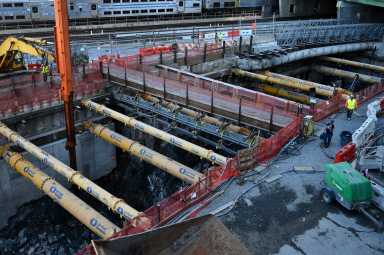
Securing court-ordered funding for the Gateway Tunnel keeps a vital infrastructure lifeline alive, with high stakes for the region’s economy and national transport resilience.
New York City has a great many superlatives: tallest, busiest, most expensive. But one of its least enviable records lies quietly beneath the Hudson River—an ageing rail tunnel, over a century old, through which roughly 200,000 daily commuters ply their way to and from Manhattan. Last week, a federal appeals court ensured that the $16bn Gateway Tunnel project, intended to replace this crumbling corridor, would not be derailed—at least not for now—by the federal government’s decision to withhold over $200m in promised funds.
On February 8th, the Second Circuit Court of Appeals declined to reverse an earlier order by U.S. District Judge Jeannette Vargas, compelling the Trump administration to temporarily unlock $205m to the Gateway Development Commission (GDC). A higher court, rather than intervening directly, punted the legal wrangling to a future motions panel, allowing Vargas’s decision to take effect. Provided bureaucratic gears do not grind further, federal reimbursement funds should begin flowing to the GDC imminently, allowing stalled construction to resume after a week-long hiatus.
Though easily mistaken for the standard-issue legal jousting endemic to big-ticket infrastructure, this episode imperils real progress on one of America’s most urgent transit projects. Work at the Hudson Tunnel had ground to a halt since February 2nd, with the GDC unable to pay contractors absent federal funds. Over 1,000 construction jobs vanished overnight, and GDC faced escalating costs for securing dormant work sites. New York and New Jersey, not short of urgent matters, were moved to joint legal action, arguing the financial chokehold would bring not just delays, but potential systemic paralysis to a region whose veins depend on reliable commuter rail.
For New Yorkers, the rebirth of the Gateway Tunnel matters less for its headline price tag and more for its functional gravity. The existing link—built in 1908 and battered by Hurricane Sandy in 2012—operates at the ragged edge of serviceability, handling Amtrak and NJ Transit trains yet plagued by leaks, electrical failures, and catastrophic maintenance backlogs. A protracted outage would not merely frustrate commuters. It would, as the states’ lawsuit bluntly put it, “paralyze” travel between New York and New Jersey and send economic aftershocks rippling up and down the Northeast Corridor.
The immediate impact is felt not only by the union sheet-metal workers and engineers now allowed back on the job, but by the wider New York metropolitan area. Business leaders fret about unpredictability in cross-Hudson access—anxiety that chokes investment and sends recruitment and retention costs higher. Tenants in Manhattan’s swelling office blocks bank on resilient daily commutes for staff. Even a brief work stoppage can add millions to the project’s cost, as idle cranes and security outlays gnaw at already tight budgets.
Beyond the regional lens, the Gateway imbroglio spotlights a wider malaise afflicting U.S. infrastructure: the frailty of federal-state partnership. While congressional appropriations have officially greenlit federal funds, the bottleneck, in this case, was bureaucratic (and, critics argue, political) intransigence within the Department of Transportation. The litigation-jammed drip-feed of federal money brings a sharp contrast with peer cities abroad. Europe, for instance, manages to widen tunnels beneath the Alps with less legal melodrama and firmer timelines. America, by contrast, sometimes appears content to let projects dangle at the mercy of shifting administrations.
The broader economic consequences of indecision bode ill: the Northeast Corridor, running from Boston to Washington, generates about a fifth of U.S. GDP. Delays to Gateway portend not only continued congestion and mounting unreliability but a national vulnerability in both commerce and daily life. The region’s chronic difficulties, from New Jersey Transit delays to the infamous “Summer of Hell” on Amtrak, are unlikely to abate so long as the status quo endures. And the health of New York’s housing and labour markets remains, at a basic level, coupled to safe and swift cross-river rail.
The GDC’s response mixes relief with wariness. “While this is a positive step, we need consistent, reliable access to the Hudson Tunnel Project’s federal funding moving forward,” the authority cautioned, even as it took a tepid victory lap. Their underlying grievance echoes a common refrain: that American public works ought not to hinge on the caprice of executive branch calculations or chess-like feuds between administrations, but rather on the less rousing virtues of steady payments and legal continuity.
Lessons in bureaucratic brinkmanship
New York’s latest brush with a work stoppage offers an inadvertent masterclass in the perils of infrastructural brinkmanship. While the Trump administration’s recalcitrance follows a wider pattern of infrastructure funding delays during its tenure, the enduring vulnerability lies deeper: future presidents, too, can drag their feet or flex leverage over major projects midstream. The courts can occasionally supply a corrective, but litigation is an inefficient substitute for clear policy and transparent rules.
Other megacities are already ahead in delivering large-scale transit modernisations thanks to less fractious central-local cooperation. London, for instance, completed the Elizabeth Line (Crossrail) after many fits but with fewer surprise funding freezes. Tokyo continues to expand its underground rail web with enviable regularity. In this global company, New York’s penchant for unpredictable delays bodes ill for its competitiveness and public morale.
Looking forward, it would be prudent for lawmakers on Capitol Hill—and their statehouse counterparts in Albany and Trenton—to reach a durable clearing for Gateway and similar ventures. That means not just appropriating funds, but ensuring agencies can disburse them in a timely, rules-bound manner, insulated from partisan deadlock. The economic payback from a safe, high-capacity tunnel dwarfs the sums under litigation (and the legal fees thus far expended), while the costs of further delay climb relentlessly, in dollars and public patience alike.
In sum, the court’s ruling is a necessary, if only partial, restoration of sanity for a project the region—and, arguably, the nation—cannot afford to botch. Whether the Gateway Tunnel ultimately emerges on time and on budget remains uncertain. What is clear, however, is that the return of $205m in federal grease has, for now, kept the wheels from coming off New York’s north-eastward arteries. ■
Based on reporting from amNewYork; additional analysis and context by Borough Brief.